The Inca Trail to Machu Picchu is one of the world’s most legendary treks, but behind every step lies a story few travelers ever hear. For decades, porters have been the true backbone of the Inca Trail, carrying tents, food, and equipment so that hikers could complete the journey.
I am Silvio Tunqui, born in the Sacred Valley, and I began my journey as a porter on the Classic 4-Day Inca Trail. Carrying heavy loads through the Andes taught me resilience, respect for nature, and the importance of community. Later, I became a professional guide, leading groups along not only the Inca Trail but also alternative treks like Salkantay, Choquequirao, Ausangate, and Lares.
Drawing from these experiences, I carefully designed the routes of Tunqui Expeditions. Every trek we offer is built on authenticity, sustainability, and fair treatment of porters. We know the Inca Trail not just as a route, but as a way of life.
With expertly crafted itineraries, small groups, local guides, and responsible tourism practices, Tunqui Expeditions is here to offer travelers the most authentic connection to Machu Picchu and the Andes.
My name is Silvio Tunqui, founder of Tunqui Expeditions and a lifelong traveler of the Andes. I was born in the Sacred Valley of the Incas, in the district of Lamay, where I grew up in the community of Poques. My childhood and teenage years unfolded at more than 4,000 meters above sea level, herding sheep, alpacas, llamas, and even guinea pigs, always accompanied by my loyal shepherd dogs.
Some might wonder: Guinea pigs at that altitude? Yes, it’s true. We fed them with Achupalla, a hardy Andean plant from the bromeliad family (such as Fascicularia bicolor and Puya hamata) that grows across South America. Through these traditions, I learned early that guinea pigs are not only a staple food in the Andes but also a nutritious and ancestral part of our identity.
From the age of one until seventeen, I lived this way—deeply connected to the land and learning the hard work of traditional farming. Many people from the cities often describe Andean families as “poor” because they lack modern houses, brand-name clothes, or formal education. But for me, we were richer than most:
We were wealthy in culture, tradition, cuisine, and community.
Yet, I also saw challenges. Many families, including my grandparents, had vast lands and herds of animals, but they did not invest in their children’s education. They could not imagine that Lamay would one day become a town with better schools and new opportunities for future generations.
Today, Andean communities still have many of these resources, but the situation is different: the climate is harsher, farmland is more limited, and raising animals requires more investment. Above all, education now requires money, and subsistence farming alone is no longer enough.
My own parents faced these struggles. With fewer animals and less land, they worked tirelessly to provide for us. My father was a hard-working man, and from childhood I learned how to sow and harvest crops, prepare fertilizer with llamas, and store seeds in the Qolqas, traditional storage houses. I woke before dawn in the freezing cold to help prepare moraya and chuño, ancestral freeze-dried potatoes that remain staples of the Andean diet.
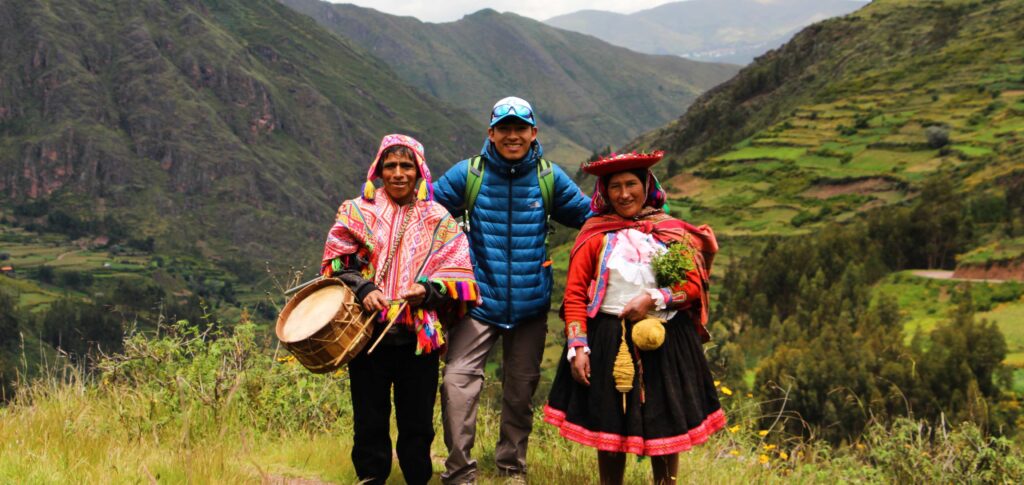
Inspired by these experiences, I am now writing a book about traditional Andean agriculture, a step-by-step guide that documents our ancestral farming practices and community values.
Some of the key elements include:
This book is my way of preserving the ancestral wisdom of the Andes, ensuring it is not forgotten but celebrated as part of our living culture.
Growing up, I also learned the communal work systems that defined our society: ayni, minka, and mita, as well as the importance of assemblies, communal responsibilities, and collective labor. All of these experiences shaped me and taught me the deep value of tradition, culture, and community unity.
My mother was equally dedicated, raising more than 100 sheep and 70 alpacas. As a family, we cared for more than 90 llamas roaming the highlands. From them, I learned how to guide animals, climb the mountains, and respect the natural wealth of the Andes. Always with my brothers, friends, and neighbors by my side, I grew up immersed in a living, rich, and profound culture that I now feel called to share with the world.
Life in the community was never enough to support higher education. Products like potatoes, chuño, and moraya had little market value, and my mother often traveled to the city to sell fresh meat, always at unfair prices. Over time, my father, like many others in the community, stopped working solely on the farm. Instead, he sought opportunities in the nearby cities of Cusco, Calca, Lamay, and Urubamba, where many locals began working with well-known travel companies such as G Adventures and Intrepid Travel.
When I was six years old, my father made this choice to provide me with a better education. By the age of sixteen, I followed the same path, beginning my journey as a porter on the Inca Trail to Machu Picchu, working alongside my uncles. For two years, I carried loads of more than 35 kilos—and my uncles would tell me stories of when porters carried up to 80 kilos, which is almost unimaginable.
Why so much weight? Because groups of more than 16 travelers were often assigned only 10 to 13 porters, when in reality, 27 to 30 porters were needed to make the loads fair and safe. Each porter carried not just camping gear and food but the weight of the entire expedition. And despite all this effort, porters were not even allowed to visit Machu Picchu after completing the trek.
This unfair reality gave me the determination to fight for my future. I realized that without education, my life would always be limited to carrying heavy loads. So, while finishing high school in my community, I worked on the Classic 4-Day Inca Trail to help pay for my studies. Afterward, I enrolled in a tourism institute, studying for more than two years while continuing to work as a porter. At the age of 20, I graduated in tourism, with English as my second language.
But my path wasn’t easy. At first, I couldn’t guide groups directly, so I gained experience in small travel agencies—working in sales, operations, and even as a street promoter selling tours. These jobs were challenging, but they taught me how the tourism industry worked and helped me shape my vision: to provide a better quality of service in tourism, built on respect, fairness, and authenticity.
Eventually, I became an Official Tourism Guide of Peru, leading one-day trips to destinations like the Rainbow Mountain, Humantay Lake, and the Sacred Valley. Yet, my true passion was guiding the great treks of the Andes—the legendary Inca Trail to Machu Picchu, the Salkantay Trek, Choquequirao, Ausangate, Lares Trek, and other alternative routes. I started as an assistant guide and, step by step, became the lead guide, sharing history, culture, and stories along every trail.
After more than two years of guiding, I knew it was time to bring my vision to life. That’s when Tunqui Expeditions was born, a company specializing in trekking and expeditions to Machu Picchu.
Tunqui Expeditions was created to transform the trekking experience in Peru. Our mission is to:
I know the Inca Trail Peru like the back of my hand—first as a porter, then as a guide, and now as a tour operator. Every route we organize is carefully designed to give travelers the best Machu Picchu trekking experience, while respecting the culture, history, and environment of the Andes.
This is how Tunqui Expeditions was born: from the mountains of my childhood, through years of hard work, and with a vision to change the way people experience the Inca Trail to Machu Picchu.






 Español
  English
